
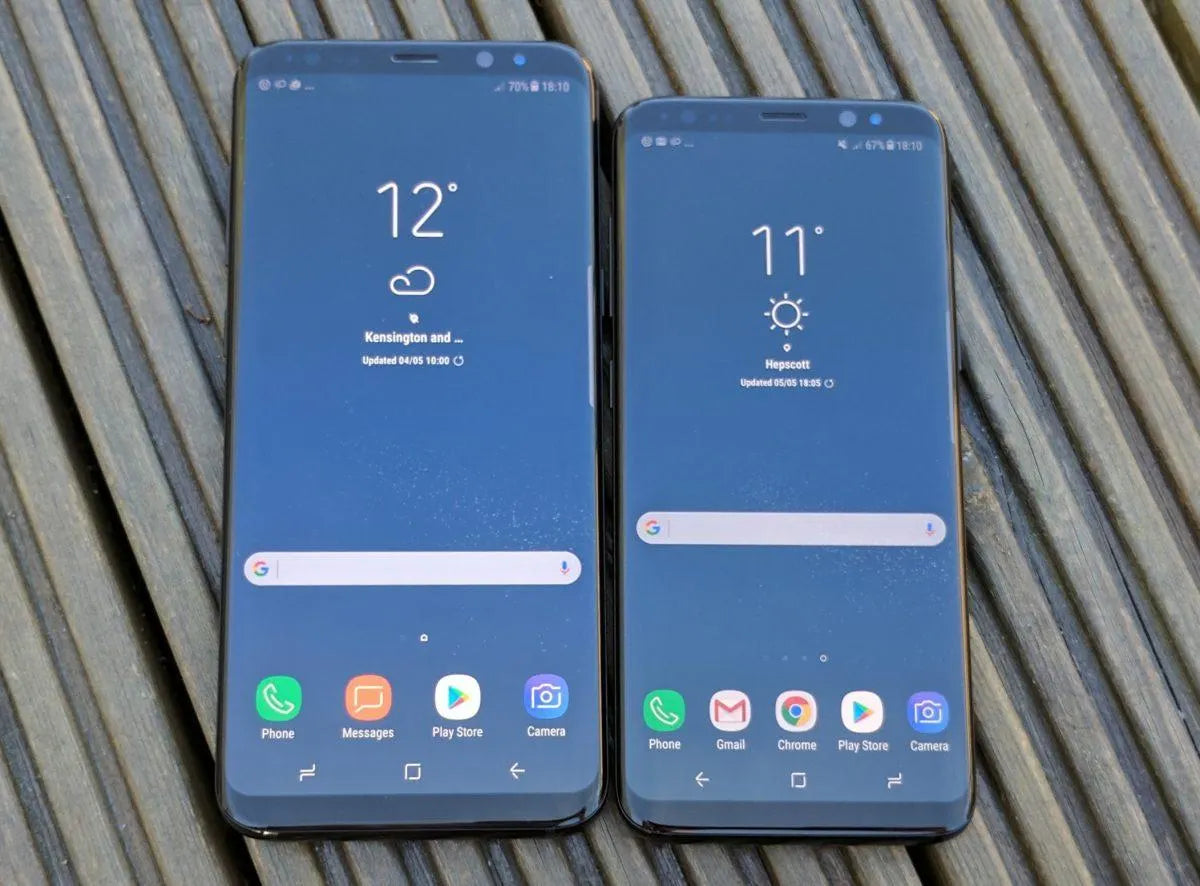
When Samsung dropped the Samsung Galaxy S8 and its bigger sibling, the S8 Plus, people genuinely lost their minds. The design looked futuristic, that Infinity Display was something nobody else was doing properly, and suddenly every other phone looked dated overnight. Fast forward, and both these handsets are still in conversations. Why? Because even today, they hold a kind of charm that most budget and even mid-range phones can’t quite replicate.
But here’s the deal—while they look like twins from across the room, they aren’t exactly the same in daily use. And if you’ve ever been stuck choosing between the two, you’ll know the confusion. Do you save your hand comfort with the smaller S8? Or do you grab the S8 Plus for the bigger battery and screen? Let’s break it all down without any sugar coating.
Design and Feel: Sleek vs Stretched
Pick up the Samsung Galaxy S8 and it feels… just right. It’s compact enough to slide into your jeans pocket without making you wince every time you sit down. The curves feel smooth, and one-handed use doesn’t feel like a circus trick.
Now, the S8 Plus? That’s a whole different story. The 6.2-inch screen gives you more of everything—videos look better, Instagram feels endless, and even reading articles is easier on the eyes. But yeah, that size comes with trade-offs.
Try using it one-handed while holding a coffee and you’ll know exactly what I mean. Both phones look stunning though. Glass front, glass back, that shiny metal frame—back then, Samsung really knew how to make a phone feel premium. Even today, these designs hold up.
Display: Same Quality, Different Scale
Samsung’s Super AMOLED panels don’t really need an intro. Deep blacks, saturated colors, crisp resolution—it’s the kind of display that spoils you for other devices.
Both the Samsung Galaxy S8 (5.8-inch) and the Samsung Galaxy S8 Plus (6.2-inch) pack a QHD+ screen. Pixel density is practically identical, so whether you pick the smaller or the larger, sharpness isn’t an issue. The only real difference? How much space you want to play with. The Plus gives you a slightly more cinematic feel, while the regular S8 keeps things compact.
Performance: Identical Under the Hood
Here’s where the choice becomes easier—they run on the same engine. The Snapdragon 835 (US) or Exynos 8895 (international) with 4GB RAM. At launch, that was flagship material. Today, sure, it’s not going to breeze through the heaviest games, but for everyday use—social media, streaming, light editing—it still holds up.
Between the two? No difference. Whether you go S8 or S8 Plus, performance is the same.
Battery: The One Real Difference
This is where the Plus earns its name. The regular S8 carries a 3,000 mAh battery, while the S8 Plus gives you 3,500 mAh. Doesn’t sound huge, but in real-world use, it adds up.
With the S8, you’re probably hitting the charger before bedtime if you’re on it all day. The Plus, on the other hand, gets you comfortably through. And since both support fast charging and wireless charging, topping up is quick and hassle-free.
Cameras: Same Shooter, Same Results
Samsung didn’t bother differentiating the cameras. You’ve got the 12MP rear with dual-pixel autofocus and an 8MP selfie camera on both.
Photos are still respectable even now—good dynamic range, nice low-light shots thanks to that f/1.7 lens, and the classic Samsung punchy colors. Selfies and video calls look fine, though by 2025 standards you’ll definitely feel the gap compared to newer phones. But back then? These cameras were top of the food chain.
So whichever you choose, camera performance won’t be the dealbreaker.
Features: Small Things That Still Count
Both phones came loaded with things people still miss today—a headphone jack, microSD card slot, IP68 water resistance, and Samsung’s always-on display. And let’s not forget: wireless charging was already here. That’s the kind of future-proofing a lot of brands still don’t nail even now.
Fingerprint placement, though… yeah, Samsung missed the mark. It sits awkwardly next to the camera lens. Most people smudged the camera more often than they unlocked their phone cleanly.
Software-wise, both shipped with Android Nougat and officially went up to Android 9 Pie. That’s dated by now, no doubt. But Samsung’s skin still feels familiar if you’ve used any of their later models—customizable, a little bloated, but functional.
Price and Value Now
At launch, the S8 Plus cost more than the S8, naturally. Today, in the used or refurbished market, you’ll find both at much friendlier prices. The Plus still holds slightly higher value because of its bigger screen and battery, but the gap isn’t crazy.
If you’re looking for a budget-friendly Samsung with premium design, either one works. Just think about whether you want compact convenience or extra stamina.
Real-Life Usage: Comfort vs Immersion
This is what it all comes down to. Using the Galaxy S8 day-to-day feels slick, light, easy. You don’t wrestle with the size. It just works.
The Galaxy S8 Plus, meanwhile, feels like carrying a mini cinema in your pocket. Movies, games, even scrolling Twitter—it’s just more immersive. But that also means bigger pockets, two-hand use more often, and a phone that’s harder to manage when you’re multitasking.
Sleek Design, Brilliant Display
At the end of it all, both the Samsung Galaxy S8 and the Galaxy S8 Plus are cut from the same cloth. Sleek design, brilliant displays, capable cameras, and solid features that still make them feel premium. The only real split? Battery and size.
-
Go with the S8 if you want something sleek, pocketable, and still stylish.
-
Go with the S8 Plus if you crave more screen, more juice, and don’t mind the extra bulk.
Either way, you’re picking a phone that left a real mark in smartphone history. And if you ever need to keep yours alive a little longer, whether it’s a replacement screen or a fresh battery, The Repair Plus in the UK has your back with quality parts and quick delivery.
Samsung Galaxy S8 & Galaxy S8 Plus Specs and Features – A Closer Look
There are certain phones you don’t just forget. You know the ones I’m talking about — the kind of devices that turn heads, spark conversations, and set new standards for what a smartphone should look and feel like. Back in 2017, that’s exactly what Samsung did when it pulled the curtain back on the Galaxy S8 and Galaxy S8 Plus.
Even now, years later, people still bring them up when talking about the “game changers” in smartphone history.
So let’s strip it down and actually talk about what these phones offered. No fancy marketing fluff, no overly technical jargon — just a straightforward, detailed walk-through of their specs and features, and why they still deserve a mention even today.
The Design That Felt Like the Future
The first thing you notice — and honestly, the thing everyone remembers — is the Infinity Display. It wasn’t just hype. The bezels practically disappeared, the glass melted into the curved edges, and suddenly it felt like we were holding a piece of the future.
-
The Galaxy S8 rocked a 5.8-inch screen. Perfect size for people who wanted something big but not massive.
-
The S8 Plus went all out with 6.2 inches of display real estate. A proper big-screen experience without the usual bulky frame.
Both used Super AMOLED panels with Quad HD+ resolution, so colors looked ridiculously vibrant. Watching a movie, scrolling through Instagram, even just browsing the web — everything popped in a way most phones at the time simply couldn’t match.
Blacks were actually black, whites were crisp, and if you turned the brightness up, it could light up a small room.
The body itself? Wrapped in glass front and back, framed by metal. Gorgeous, though yeah — it loved fingerprints. Still, when you held it, it felt premium.
Slim in the hand, curved edges making it look thinner than it really was. Honestly, phones today owe a lot to the design language Samsung introduced here.
Under the Hood – Power That Still Surprises
Now, specs. Depending on where you lived, you got either:
-
Snapdragon 835 (U.S.)
-
Exynos 8895 (most other countries)
Pair that with 4GB of RAM and 64GB storage (expandable via microSD up to 256GB), and you had one of the most capable devices of its time. Apps opened quickly, multitasking was smooth, and games ran without breaking a sweat.
Even today, for basic use, these chips don’t feel completely outdated. Sure, they won’t compete with 2025 flagships, but for day-to-day tasks — social media, browsing, calls, messages — they still hold their own surprisingly well.
Cameras That Changed Expectations
This is where Samsung quietly flexed. The 12MP rear camera might sound modest compared to today’s triple and quad setups, but back then, it was a beast.
-
Dual Pixel autofocus meant it locked onto subjects lightning-fast.
-
f/1.7 aperture made low-light photography possible without turning your photo into a grainy mess.
-
Video recording? Smooth and sharp, with optical image stabilization keeping things steady.
On the front, the 8MP selfie camera even had autofocus. Not many phones offered that in 2017. It meant selfies were actually sharp, not just lucky guesses. Honestly, this camera setup aged really well.
Unlocking Your Phone – The Options
Samsung didn’t just stick to a fingerprint scanner. They gave you choices.
-
Fingerprint sensor — although its placement next to the rear camera annoyed a lot of users.
-
Iris scanner — futuristic, though a bit hit or miss in real-world use.
-
Facial recognition — basic, but convenient.
It wasn’t perfect, but the fact that Samsung loaded in so many ways to unlock your phone felt fresh and forward-thinking.
Battery Life That Didn’t Disappoint
Battery capacity looked like this:
-
S8: 3,000mAh
-
S8 Plus: 3,500mAh
On paper, not jaw-dropping. But in real use, both phones easily made it through a full day with moderate use. The Plus model obviously stretched further, thanks to its larger cell.
And both supported fast charging and wireless charging — which in 2017 felt like magic. Just dropping your phone on a pad instead of fumbling with cables? Still satisfying.
Software Experience
Out of the box, the S8 series shipped with Android Nougat alongside Samsung’s new UX. Cleaner, smoother, and less bloated than previous TouchWiz days. Later updates brought them up to Android 9 (Pie), and that’s where official support ended.
Still, the software experience had gems:
-
Always-On Display: glance at the time and notifications without waking the phone.
-
Edge Panels: swipe in from the side for shortcuts, contacts, and more.
-
Samsung DeX: plug it into a dock, and suddenly your phone became a mini computer.
Not everyone used these, but the point was — the S8 series was packed with thoughtful extras.
The Little Details That Made a Big Difference
Here’s what made people smile:
-
IP68 water and dust resistance — spill your drink or get caught in rain, no panic.
-
3.5mm headphone jack — something newer phones have abandoned, but was priceless back then.
-
Expandable storage — handy if you didn’t want to rely on cloud services.
These weren’t flashy features, but they made the phone practical.
S8 vs. S8 Plus – Which One Made More Sense?
Truth be told, the difference was simple:
-
The Galaxy S8 was for those who valued compact design, one-hand use, and portability.
-
The S8 Plus was for big-screen lovers who wanted extra battery life.
Specs, cameras, features — everything else was identical. So really, it boiled down to size preference.
Are They Worth Talking About Today?
That’s the big question. Should anyone care about the Galaxy S8 series almost a decade later? The honest answer: yes and no.
-
Yes, if you’re after a budget backup phone, or just something stylish for basic use. They still look modern enough and handle daily tasks fine.
-
No, if you want the latest 5G support, cutting-edge performance, or multi-lens cameras. These phones can’t keep up with the absolute best anymore.
But here’s the thing: they remind us of a moment when smartphones truly took a leap forward. That counts for something.
Conclusion
The Samsung Galaxy S8 and Samsung Galaxy S8 Plus weren’t just another pair of flagships. They were statement pieces. They pushed design forward with the Infinity Display, nailed performance with powerful chipsets, and introduced extras like water resistance, wireless charging, and iris scanning before they were mainstream.
Even now, holding one doesn’t feel like handling an antique. It feels like revisiting a device that helped shape what our current smartphones have become. And that, in itself, is a legacy worth remembering.
Share:
iPhone 6S Screen Replacement Cost and Repair Guide
Samsung Galaxy S8 Plus Features and Specs Guide