
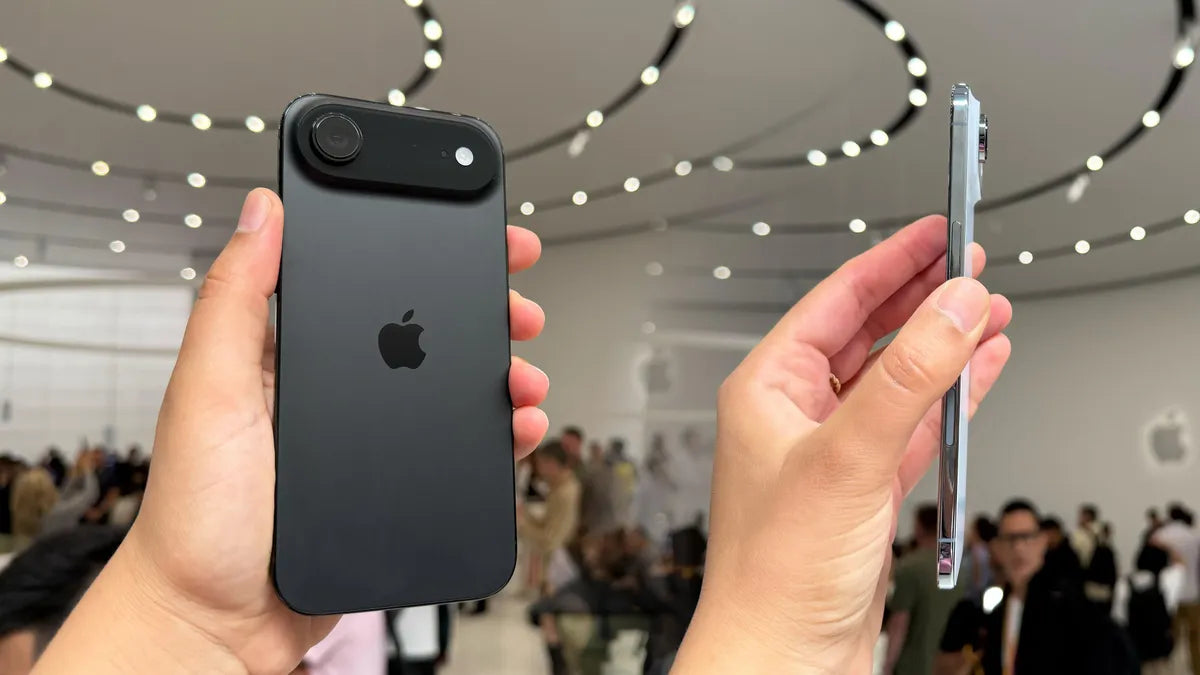
iPhone 17 Air Rumors: Apple's Thinnest iPhone Ever Coming? Apple's apparently working on something pretty wild for 2025. The iPhone 17 Air looks set to be the thinnest smartphone the company has ever made, and honestly, it's about time we saw something genuinely new in iPhone design.
Multiple sources close to Apple's supply chain are suggesting we're looking at a device that's somewhere around 5mm to 6mm thick – that's absolutely mental when you consider the current iPhone 15 Pro measures 8.25mm.
This isn't just Apple shaving off a millimeter here or there. We're talking about a complete reimagining of what an iPhone can be. The "Air" branding tells us everything we need to know about where Apple's head is at with this one.
They've done it successfully with MacBooks and iPads, so why not bring that same philosophy to the iPhone? The design-focused approach here suggests Apple's finally ready to give us something that prioritizes feel and aesthetics over cramming in every possible feature.
Look, the iPhone design has been pretty stagnant lately. Sure, we get new colors and slightly different camera bumps each year, but nothing that makes you go "wow, that's different." The iPhone 17 Air might actually be that device. Whether it's brilliant or a complete disaster remains to be seen, but at least it's interesting.
When Can We Actually Get Our Hands On It?
September 2025 is the target. Apple's not exactly known for surprises when it comes to their launch schedule, and everything we're seeing suggests they're sticking to their usual playbook. Expect the big reveal during the first or second week of September, with phones hitting shelves about ten days after the announcement. Pre-orders will likely open the Friday following the event, which means we're probably looking at late September delivery dates for anyone quick on the draw.
Now, here's where things get interesting. Manufacturing an ultra-thin device isn't exactly straightforward. Apple's suppliers have apparently been dealing with some pretty significant challenges getting everything to fit into such a constrained space.
Production likely kicked off in July or August to give them enough runway, but don't be shocked if initial supplies are tight. The thinnest iPhone ever sounds great until you realize how hard it is to actually make the thing.
We've seen Apple delay launches before when manufacturing hasn't cooperated, though they really hate doing that. The pressure to stick to the September timeline is immense – they've trained consumers to expect new iPhones in fall, and breaking that pattern would be a big deal. Still, if there's one thing we've learned about Apple, it's that they won't ship something before it's ready. Well, usually.
The Engineering Nightmare of Making It This Thin
Let's talk about the elephant in the room. Getting a smartphone down to 5mm thick isn't just about squashing everything together. It's a fundamental rethinking of how you build a phone. Every single component inside the iPhone 17 Air needs to be redesigned, reengineered, or completely reimagined. The battery is thinner. The logic board is more compact. The speakers are microscopic. Even the buttons need special attention.
Apple's engineers have presumably been working on this for years. You don't just wake up one morning and decide to make the world's thinnest iPhone. This requires custom components that don't exist anywhere else, new manufacturing techniques, and probably a fair bit of trial and error. The structural integrity concerns alone are massive – nobody wants a phone that bends in their pocket like that infamous iPhone 6 Plus disaster.
Materials science becomes crucial here. We're probably looking at some exotic aluminum alloy or possibly titanium, despite the cost. The chassis needs to be rigid enough to prevent flexing while being thin enough to hit that target measurement. Apple's got the resources to pull this off, but it's not cheap and it's definitely not easy.
Think about the camera bump too. Current iPhones have these huge camera islands that stick out several millimeters. If the entire phone is only 5mm thick, what happens to the cameras? Either they're flush with the body (unlikely given physics), or the camera bump becomes proportionally enormous. Neither option is particularly elegant, which suggests Apple's found some third way we haven't thought of yet.
Screen Technology That Makes This Possible
The display is probably where Apple's made the most progress. Modern OLED panels can be incredibly thin, especially when you integrate the touch layer directly into the screen stack. We're likely seeing the latest generation of flexible OLED from Samsung or LG, possibly with some Apple-specific customizations that push thickness even lower.
But here's the problem with super thin displays – they're fragile. Glass breaks more easily when it's thinner. So either Apple's using some new glass formulation that's stronger despite being thinner, or they're going with a different material entirely. Ceramic Shield has been their go-to for a few years, but that might not cut it here. Some rumors mention sapphire crystal, which would be expensive but could work.
In iPhone 17 Air Rumors the screen still needs to hit 120Hz ProMotion refresh rates, support HDR, and get bright enough for outdoor visibility. None of that changes just because the phone is thinner. Actually, making displays brighter typically requires more backlighting, but OLEDs are self-emissive, so that's one advantage. Still, power consumption becomes a bigger concern when your battery is necessarily smaller.
Battery Life: The Unavoidable Compromise
Here's where the iPhone 17 Air is going to catch heat. Simple physics dictates that thinner phones have smaller batteries. You can't cheat thermodynamics. We're probably looking at battery capacity somewhere in the 2500mAh to 3000mAh range, which is significantly smaller than the 3877mAh in the iPhone 15 Pro Max.
Apple will spin this six ways from Sunday. They'll talk about the efficiency gains from the A19 chip. They'll mention intelligent power management in iOS 19. They'll point to fast charging and optimized wireless charging. And you know what? All of that helps, but it doesn't change the fundamental reality that less battery means less usage time.
The target market here probably doesn't care as much about all-day battery life. These are people who charge their phones at their desk, in their car, and on their nightstand. They're not backpacking through wilderness areas where the next outlet is three days away. Still, it's going to be a tough pill to swallow for many users who've gotten used to iPhones that easily last a full day.
Fast charging becomes basically mandatory. If you can top up 50% in fifteen minutes, the smaller battery becomes more manageable. You grab quick charges throughout the day instead of relying on one full charge lasting forever. It's a different usage pattern, but it can work if the infrastructure is there.
Camera Compromises We're Definitely Going To See
The camera system is where Apple's going to have to make some real sacrifices. There's just no way around it. Camera modules physically require a certain amount of depth for the optics to work properly. You can only make a camera sensor so thin before image quality suffers dramatically.
Expect the iPhone 17 Air to skip the telephoto lens entirely. It'll probably have a wide and ultra-wide setup, similar to the base iPhone models. The sensors will likely be smaller than what you find in the Pro models too. Now, Apple's computational photography is genuinely impressive – they can do remarkable things with software. But there are limits to what algorithms can achieve when the hardware isn't there.
The camera bump is going to look ridiculous. If the phone body is 5mm and the cameras need to be 8mm, you've got a 3mm bump that's more than half the phone's thickness. That's going to create a wobbly table effect when you lay the phone down flat. Some people won't care. Others will hate it. Apple's designers presumably decided the tradeoff was worth it.
Portrait mode, Night mode, and all the computational stuff should still work fine. The processing happens in the chip, not the camera hardware. But optical zoom? Forget about it. Low-light performance? Probably a step back from the Pro models. This is a camera system designed for Instagram and FaceTime, not for replacing your DSLR.
Processing Power In A Wafer-Thin Package
The A19 chip needs to be an absolute marvel of engineering. It's got to deliver flagship performance while generating minimal heat, because there's nowhere for that heat to go in such a thin device. Apple's advantage here is vertical integration – they design the chip specifically for the thermal constraints of the iPhone 17 Air.
We're probably looking at a 3-nanometer process, possibly second or third generation 3nm if TSMC's roadmap stays on track. Smaller transistors are generally more efficient, which helps. The chip will have aggressive power gating and dynamic voltage scaling to minimize heat generation during normal use. Gaming for extended periods might be problematic, though.
Thermal throttling becomes a much bigger factor in thin devices. There's less metal to act as a heat sink, and the surface area for dissipating heat is reduced. In iPhone 17 Air Rumors Apple's going to implement pretty aggressive thermal management that might limit sustained performance. Benchmarks will look great for the first thirty seconds, then things might slow down once the device heats up.
For typical usage – browsing, social media, messaging – none of this matters. The phone will feel incredibly fast. It's only when you push it hard for extended periods that the thermal limitations become apparent. Most people never push their phones that hard anyway, so it's probably a reasonable tradeoff.
5G Antennas In Something This Thin?
Getting good 5G performance in an ultra-thin device is genuinely challenging. Antennas need specific physical dimensions to work efficiently at different frequencies. Millimeter-wave 5G antennas in particular require careful placement and design. Apple's antenna engineers have their work cut out for them.
The solution probably involves distributed antenna arrays spread throughout the device's perimeter. Apple might use some of those advanced metamaterial antennas they've been researching. In iPhone 17 Air Rumors These can achieve good performance in smaller packages than traditional antenna designs. Patents suggest they've been working on this for a while.
Don't be surprised if mmWave support is limited or even absent from some international versions of the iPhone 17 Air. Outside the United States, mmWave deployment is pretty sparse anyway. Most 5G networks globally use sub-6GHz frequencies, which are easier to accommodate in thin devices. Apple might decide the engineering complexity of mmWave isn't worth it for this particular model.
Wi-Fi and Bluetooth antennas are less problematic since they operate at higher frequencies with shorter wavelengths. Still, everything needs to be carefully positioned to avoid interference between all the radios crammed into this tiny space. Antenna performance is one of those things that's invisible when it works well but becomes immediately obvious when it doesn't.
Audio Quality When There's No Room For Speakers
Traditional smartphone speakers need volume – as in physical internal volume, not loudness – to produce decent sound. The iPhone 17 Air's speaker situation is going to be interesting. Apple might use piezoelectric speakers, which can be much thinner than traditional dynamic drivers. These are common in premium earbuds but less typical in phones.
Stereo sound will still be there, probably using the earpiece as one channel and a bottom-firing speaker as the other. The tonal quality might be different from what we're used to, though. Piezoelectric speakers can sound somewhat bright or tinny compared to traditional speakers. Apple's audio tuning team is excellent, but they're working with some serious constraints here.
Phone calls might actually benefit from the thin design. Bone conduction technology works better when the device can vibrate against your skull, and a lighter, thinner phone could potentially do this more effectively. FaceTime audio quality should remain excellent since that's more about the microphone array and processing than speaker quality.
For serious music listening, everyone's using AirPods or other headphones anyway. The built-in speakers are mostly for speakerphone calls, watching quick videos, or notifications. As long as they're adequate for those use cases, most people probably won't complain.
iOS Features Built Around This Specific iPhone
iOS 19 will almost certainly have features specifically designed for the iPhone 17 Air. We might see new power management modes that aggressively optimize for the smaller battery. In iPhone 17 Air Rumors There could be grip detection preventing accidental touches on the ultra-thin edges. Haptic feedback might be tuned differently to account for the reduced mass.
Apple's really good at this kind of holistic optimization. They control the entire stack from silicon to software, which means they can make adjustments at every level to compensate for hardware constraints. Some of these optimizations will probably make their way to other iPhone models eventually, but they'll debut on the Air.
The Always-On Display feature might be more limited here given battery concerns. Or it might be more aggressive about dimming or blanking the screen when not needed. Little software tweaks like this can significantly impact real-world battery life without users even noticing the difference.
There's also potential for new user interface paradigms that take advantage of the thin form factor. Maybe new gesture controls that use the entire edge of the device. Perhaps improved hand-off features with other Apple devices since the Air is so portable. In iPhone 17 Air Rumors Apple's usually pretty clever about finding ways to make hardware limitations feel like features.
Colors That'll Make You Want To Buy It
Apple knows that an ultra-thin phone is all about aesthetics, so the color options need to be spectacular. We're probably looking at sophisticated, premium finishes rather than the playful colors they offer on base model iPhones. Think along the lines of what they do with iPad Air – space gray, silver, maybe rose gold or some new metallic finish.
The thinness actually makes colors more impactful. There's something visually striking about a super slim device in a beautiful finish. It catches light differently. It feels different in your hand. In iPhone 17 Air Rumors Apple's material science team will spend countless hours perfecting the anodization or PVD coating to get exactly the right look.
Limited edition colors aren't out of the question. Apple occasionally does this to create buzz and drive demand. An exclusive launch color available only for the first few months could create urgency. Or maybe a partnership with a fashion brand for a special edition. The iPhone 17 Air is positioned perfectly for that kind of marketing play.
What's This Going To Cost Us?
Let's be real – the iPhone 17 Air won't be cheap. We're probably looking at $999 to $1,099 starting price, maybe higher. Apple's going to position this as a premium alternative within the iPhone lineup, sitting between the standard and Pro models in price.
The engineering required to make something this thin is expensive. Custom components, specialized manufacturing, lower production yields due to difficulty – all of that costs money. Apple's not going to eat those costs; they're passing them along to consumers who value the design enough to pay for it.
Storage will probably start at 256GB. Apple's been moving away from 128GB base storage on their higher-end devices, and it makes sense here. The target customer for this phone isn't price-sensitive. They want the thinnest iPhone, and they're willing to pay for adequate storage to match their expectations.
Trade-ins and carrier deals will help soften the blow. If you're coming from an iPhone 13 Pro or newer, you'll probably get decent trade-in value. Carriers will offer their usual installment plans and promotional credits. Very few people pay full retail upfront for iPhones anymore anyway.
Who's Actually Going To Buy This Thing?
The target market for the iPhone 17 Air is pretty specific. These are style-conscious buyers who prioritize aesthetics and portability over maximum specifications. Think fashion industry professionals, designers, executives who want the latest status symbol, and Apple enthusiasts who need to have the newest thing.
These aren't the people who obsess over battery life or camera specifications. They charge their phones multiple times per day and they're fine with that. They probably have multiple Apple devices – an iPad for serious work, an Apple Watch for fitness tracking, AirPods Pro for music. The iPhone is just one piece of their ecosystem.
There's also the "because it's there" crowd. Some people will buy the iPhone 17 Air purely because it's the thinnest smartphone available. It's a conversation piece. It's something to show off. That's a legitimate use case, even if it seems shallow to tech enthusiasts who care more about specifications.
Business travelers might genuinely appreciate the reduced weight and size. When you're living out of a carry-on bag and every ounce matters, a significantly thinner and lighter phone has real practical value. Same for people who do a lot of walking or standing where pocket bulk becomes annoying.
What This Means For The Competition
Samsung's going to respond. They always do. Within six months of the iPhone 17 Air launch, we'll probably see leaks about an ultra-thin Galaxy S26 variant or whatever they decide to call it. Chinese manufacturers like Xiaomi and OPPO will follow suit. The entire industry tends to chase whatever trend Apple sets.
But here's the thing – nobody else has Apple's vertical integration. They can't optimize the entire stack the same way. They're stuck with whatever Qualcomm ships for processors, and Android isn't nearly as tuned for specific hardware. Building an ultra-thin phone is much harder when you don't control every aspect of the hardware and software.
We might see a renewed focus on device thinness across the industry for the next couple of years. Then something else will become the hot trend and everyone will move on. Remember when every phone tried to have the thinnest bezels? Or the highest screen-to-body ratio? Tech marketing moves in cycles.
The real question is whether consumers actually want thinner phones. A vocal segment definitely does, but there's also plenty of people who'd rather have bigger batteries and better cameras than save a few millimeters. Apple's presumably done their market research and decided there's a viable market here.
Environmental Impact Of Ultra-Thin Design
In iPhone 17 Air Rumors Apple's going to make a big deal about the environmental credentials of the iPhone 17 Air. Expect marketing around recycled materials, renewable energy in manufacturing, and reduced packaging. Less material in the phone itself could be positioned as an environmental benefit, though that's somewhat debatable.
Thinner phones might actually be worse for the environment if they're more fragile and need to be replaced more frequently. Durability is a key component of sustainability. A phone that lasts five years is much better for the planet than one that needs replacing after two years, regardless of how much recycled aluminum it contains.
Repairability is another concern. Ultra-thin devices are typically harder to repair because everything is so tightly integrated. Batteries are often glued in place. Components are soldered rather than modular. Apple's facing increasing pressure from right-to-repair advocates and regulators on this front.
The company will need to balance these competing priorities carefully. They want to tout environmental leadership, but they also want to sell lots of iPhones. Sometimes those goals align, and sometimes they don't.
Samsung Galaxy S8 Carphone Warehouse Price & Offers
Share:
Samsung Galaxy S8 Plus Features and Specs Guide
iPhone 17 vs Samsung S26 | Complete Specs Comparison